
Which Fire Extinguisher Colours Mean What
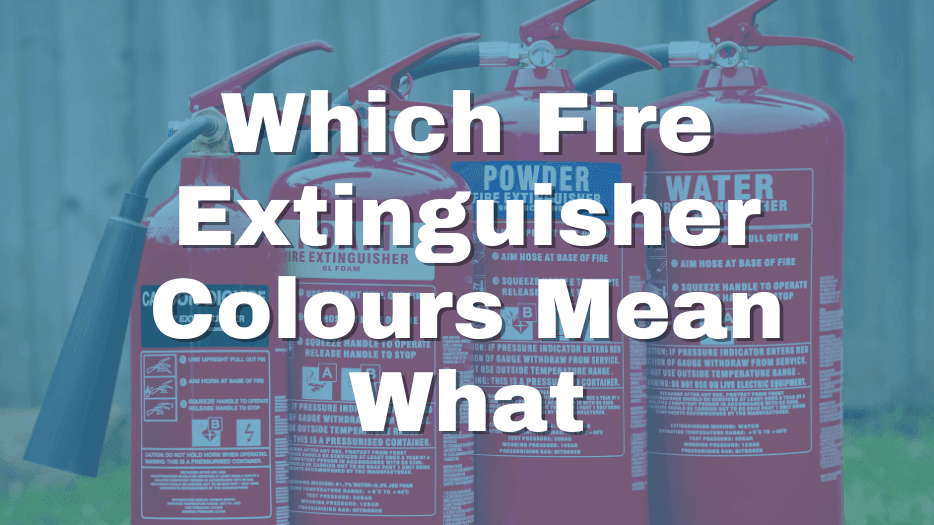
Picture this: a small fire breaks out near your electrical switchgear. Someone grabs the nearest extinguisher - but it's the wrong type. Within seconds, the situation worsens rather than improves. In the confusion, nobody noticed the colour-coded label that would have told them instantly whether that extinguisher was safe to use. That's what Fire Extinguisher colours are for!
In the UK, every portable Fire Extinguisher carries a colour-coded label that identifies its extinguishing agent - and, critically, the types of fire it's designed to tackle. This is not a discretionary system. It is governed by BS EN 3 (the British and European standard for portable fire extinguishers) and underpins the selection guidance set out in BS 5306-8:2023. Knowing what each colour means - and equally what it does not mean - is a practical Fire Safety obligation for any Responsible Person managing commercial premises.
The Big Picture
- All UK Fire Extinguishers have red bodies. Under BS EN 3, at least 95% of every extinguisher body must be Signal Red (RAL 3000). A colour-coded band or panel - covering 5-10% of the body surface - identifies the agent type. There is no such thing as an all-blue or all-black extinguisher in the UK.
- Five main agent types, five label colours. Water carries no additional band (all red). Foam is cream. CO2 is black. Dry powder is blue. Wet chemical is yellow. A sixth type - water mist - carries a white band and is increasingly common for mixed-risk environments.
- UK fire classes are different from the US system. The UK uses the European classification (BS EN 2): Classes A, B, C, D and F. There is no Class E or Class K in UK fire safety. Electrical fires are not assigned a class letter - suitability for electrical fires is indicated by an electric spark symbol on the extinguisher label.
- Provision is governed by the FSO 2005, not guesswork. The Regulatory Reform (Fire Safety) Order 2005 requires the Responsible Person to carry out a suitable and sufficient fire risk assessment (Article 9) and to ensure the premises are equipped with appropriate firefighting equipment where necessary (Article 13). BS 5306-8:2023 provides the technical selection and positioning guidance used to demonstrate compliance.
- Maintenance is a structured, legally relevant regime. BS 5306-3:2017 sets out monthly visual checks (Responsible Person), annual professional servicing, five-year extended service and ten-year CO2 overhaul. Following this schedule is the recognised method for demonstrating compliance with the FSO's Article 17 maintenance duty.
The UK Colour-Coding Standard: What BS EN 3 Actually Requires
If you have come across Fire Extinguisher guidance written for the US market, it is worth resetting your expectations. American extinguishers historically used entirely different body colours. UK and European extinguishers do not work that way. Since the adoption of BS EN 3, all portable Fire Extinguishers sold in the UK must have a body that is at least 95% Signal Red (RAL 3000).
The agent type is shown by a colour-coded band or panel on the upper body, typically near the label. This small strip of colour - covering roughly 5-10% of the surface - is what you need to check before picking up any extinguisher. Getting this right in an emergency means recognising those bands under pressure, in poor lighting and often at speed. That is why regular familiarity checks and clearly visible positioning matter as much as having the right extinguishers in the first place.
One exception: water extinguishers carry no separate colour band. The body is entirely red, with no additional panel colour. In practice, this means an all-red extinguisher is a water type - and water types are for Class A solid-material fires only.
UK Fire Classes: The A, B, C, D, F System
Before looking at which extinguisher does what, it helps to understand the UK fire classification system. The UK follows the European standard BS EN 2. There are five fire classes relevant to commercial premises:
- Class A - Solid combustible materials: wood, paper, cardboard, textiles, plastics. The most common class in offices, warehouses, retail and educational settings.
- Class B - Flammable liquids: petrol, diesel, paint, solvents, oil-based products. Relevant wherever flammable liquids are stored or used.
- Class C - Flammable gases: propane, butane, methane, natural gas. Less commonly addressed by portable extinguishers - the standard approach for gas fires is to isolate the supply if it is safe to do so.
- Class D - Combustible metals: lithium, magnesium, sodium, aluminium swarf. Specialist risk, typically found in manufacturing or battery storage environments. Standard extinguishers are not effective on Class D fires - specialist agents are required.
- Class F - Cooking oils and animal or vegetable fats: deep fat fryers, chip pans, commercial catering equipment. Not to be confused with Class B flammable liquids - burning cooking oil behaves differently and requires a different suppression method.
A critical point: electrical fires are not a separate fire class in the UK. There is no Class E. When an electrical fault ignites a fire, the fire itself is classified by the material burning - the electrical source is the cause, not the classification. Whether a given extinguisher can be used safely near live electrical equipment is indicated by an electric spark symbol on the extinguisher label, not a letter class.
Common Types and Their Colour Labels
Water - all-red body, no separate colour band - Class A only
The most basic and widely used type for general premises. Effective on Class A solid-material fires but must never be used on Class B flammable liquids, Class F cooking fires or near live electrical equipment. Standard water jet extinguishers conduct electricity and create a serious electrocution risk. The one exception is water mist extinguishers that have been di-electrically tested to 35 kV per BS EN 3 - these carry a white band and can be used near electrical equipment up to 1,000 V, provided the specific model carries the electrical safety rating.
Foam (AFFF) - cream label - Class A and Class B
A versatile choice for premises with both solid-material and flammable liquid risks. Foam smothers the fire surface, preventing re-ignition. Like standard water extinguishers, foam is water-based and conductive - it is generally not considered safe for use on live electrical equipment. Effective for Class A and B risks, but not suitable for Class C gas fires, Class D metal fires or Class F cooking oil fires.
CO2 (Carbon Dioxide) - black label - Class B and electrical
The standard choice for server rooms, electrical panels, office environments with significant IT equipment and any location where residue-free suppression is important. CO2 displaces oxygen to extinguish the fire. It is not effective on Class A solid-material fires - it does not cool, so re-ignition of wood or paper is likely once the CO2 disperses. CO2 extinguishers carry a black label/band. They are not blue. Confusing the two with dry powder extinguishers is a dangerous error.
Dry Powder (ABC) - blue label - Class A, B, C and electrical
Technically versatile - rated for Class A, B and C fires and suitable near live electrical equipment. However, BS 5306-8:2023 introduces an important caution: dry powder should not be specified for use indoors unless a risk assessment justifies it. The powder cloud created on discharge dramatically impairs visibility, causes significant clean-up challenges and presents inhalation risks. For most commercial premises, powder extinguishers are better suited to outdoor or vehicle-based use than office or industrial interiors.
Wet Chemical - yellow label - Class F and Class A
The correct choice for commercial kitchens, catering facilities and any premises with deep fat fryers or cooking oil processes. Wet chemical works by reacting with burning oil to form a soapy layer that cools and seals the fire surface - a process known as saponification. It also carries a Class A rating, making it effective on solid-material fires as well. Wet chemical extinguishers must not be used on Class B flammable liquids, Class C gas fires, Class D metal fires or live electrical equipment.
Specialist Powder - Class D metal fires
Standard ABC powder extinguishers are ineffective - and potentially dangerous - on Class D metal fires. Specialist agents such as M28 or L2 powder are required and these extinguishers should be specified by a competent person with direct knowledge of the metal fire risk present. If your premises include lithium battery storage, metal machining or processing of reactive metals, this is a specialist area requiring expert assessment beyond the scope of standard extinguisher provision.
Selecting the Right Provision for Your Premises
The Regulatory Reform (Fire Safety) Order 2005 (FSO 2005) requires the Responsible Person to carry out a suitable and sufficient fire risk assessment (Article 9). Based on that assessment, Article 13 requires appropriate firefighting equipment to be provided where necessary. The FSO does not specify types, quantities or ratings - those specifics come from BS 5306-8:2023, the British Standard for selection and positioning of portable Fire Extinguishers.
BS 5306-8:2023 recommends a minimum of two Class A rated extinguishers per storey, with an aggregate rating of at least 26A. Premises under 50 m² may be covered by a single extinguisher - a provision introduced in the 2023 edition of the standard. For Class B flammable liquid risks, the relevant extinguisher should be positioned no more than 10 metres from the hazard. For Class F cooking fires, the wet chemical extinguisher should be positioned near the cooking appliance. The maximum travel distance to reach a Class A extinguisher from any point in the premises should not exceed 30 metres.
Beyond the minimum provision, the appropriate mix of extinguisher types is determined by the specific risks present - the types of material stored, processes carried out and equipment in use. A single-type provision rarely covers all credible fire scenarios in anything other than the most straightforward of premises.
Placement and Positioning
Having the right extinguishers is only part of the picture. BS 5306-8:2023 is equally prescriptive about where they go and how they are mounted.
Extinguishers should be wall-mounted on appropriate brackets - never left free-standing on the floor, where they can be knocked over, obscured or overlooked. Mounting height matters: for extinguishers up to 4 kg total mass, the handle should be at approximately 1.5 metres from the floor. For heavier units, approximately 1.0 metre. These heights ensure the extinguisher can be lifted safely and operated without strain under emergency conditions.
Position extinguishers on exit routes, near identified hazards and at consistent locations that people will be able to find without searching. Signage above mounting points helps in larger or more complex premises. The aim is to ensure that in an emergency, no one is running more than 30 metres to reach a Class A extinguisher - and that the extinguisher is immediately recognisable and accessible when they get there.
In kitchens, the wet chemical extinguisher should be positioned close to the cooking equipment but not so close that a fire at the fryer would block access to it. A practical rule: near enough to reach in seconds, far enough that the hazard itself is not in the way.
Maintenance: Who Does What and When
The FSO 2005 Article 17 places a legal duty on the Responsible Person to maintain firefighting equipment in efficient working order. The recognised framework for doing so is BS 5306-3:2017, the code of practice for commissioning and maintenance of portable Fire Extinguishers. Following BS 5306-3 is the standard by which fire and rescue authority inspectors assess Article 17 compliance.
The maintenance regime has four distinct components:
- Monthly visual inspections - carried out by the Responsible Person or a nominated person, not by an external engineer. These checks confirm the extinguisher is in position, accessible, undamaged, the pressure gauge arrow is in the green zone, the tamper seal is intact and the instructions are legible. Record the outcome and date.
- Annual basic service - carried out by a competent person, typically a technician employed by a BAFE SP101 registered organisation. This involves full external examination, pressure and weight verification, component and seal inspection and a new service label. BS 5306-3 recommends this is completed within a 12-month period (±1 month of the previous service date).
- Extended service at five-year intervals - applies to water, foam, powder and wet chemical extinguishers. This is a more invasive procedure involving test discharge, internal inspection, component replacement and refilling. At this stage it is often more cost-effective to replace the unit than to service it - your contractor should advise you.
- CO2 overhaul at ten-year intervals - involves hydraulic pressure testing of the cylinder. No extinguisher of any type should remain in service beyond 20 years from manufacture.
When selecting a maintenance contractor, look for a company that is registered under BAFE SP101 - the competency scheme for portable Fire Extinguisher organisations and technicians. BAFE SP101 registration means the organisation has been independently assessed against the technical requirements of BS 5306-3 and BS 5306-8 by a UKAS-accredited certification body. It is the clearest independent signal of competence in this area.
Before You Go
The colour-coded label on a Fire Extinguisher is a safety-critical piece of information. In the UK, that label sits on a predominantly red body - the colour band tells you the agent, the body colour alone tells you very little. Before relying on any Fire Extinguisher guidance, check whether it was written for the UK market: the differences between UK and US systems - different fire classes, different colour conventions, metric distances and a legislative framework built around the FSO 2005 rather than building codes - are significant enough to make US-sourced content actively misleading in a UK commercial setting.
Three practical takeaways for any Responsible Person reviewing their extinguisher provision:
- Check your extinguisher types against the actual fire risks identified in your Fire Risk Assessment - not just what came with the building or what the previous occupant left behind.
- Confirm your maintenance contractor holds BAFE SP101 registration. Annual basic service is the minimum professional requirement; ask when your units are due for extended service or CO2 overhaul.
- Ensure monthly visual checks are being carried out and recorded by a nominated person on site. This is a Responsible Person obligation under Article 17 of the FSO 2005 - not something to leave until the annual engineer visit.

This article is provided for general information and educational purposes only. It is not legal advice, a fire risk assessment, a compliance audit, a technical specification, or a substitute for advice based on inspection of your premises. You should not rely on it as the basis for taking action, delaying action, or deciding not to act. Your legal duties, fire safety arrangements and system requirements depend on your specific premises, use, occupancy, risk profile and the findings of a suitable and sufficient fire risk assessment.
Fire safety and security legislation, standards, guidance and enforcement practice can change. Armoury Security + Fire makes no representations or guarantees, express or implied, that content on this site is accurate, complete or current. For practical advice about fire alarm systems, emergency lighting, security systems or system maintenance requirements for your premises, call Armoury Security + Fire on 01323 725 190.
For legal advice, fire risk assessment advice or confirmation of your statutory duties, speak to an appropriately qualified legal adviser, competent fire risk assessor or competent fire safety professional.